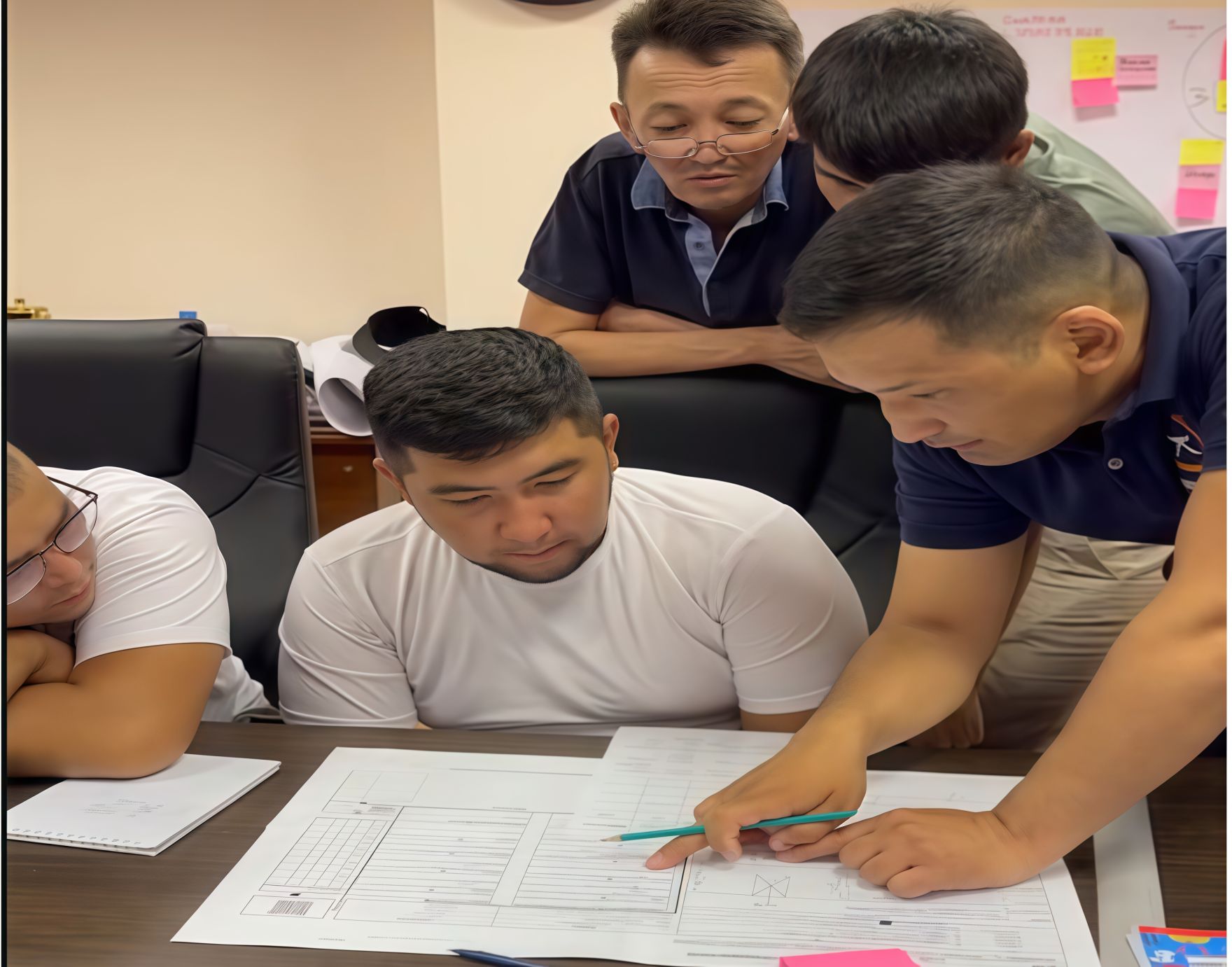
Day 1: Facts and Roots – Basic Quality Tools
Focus of the day: Learning to collect reliable data, structure problems, and separate facts from opinions.
Introductory block
- Course opening: goals, expectations, the rule «gemba – the main teacher».
- What is TQM: evolution from quality control to total quality management.
- PDCA cycle – the heart of TQM.
- Seven quality tools: overview and place in PDCA.
Practice: Business game «Production»
- Introduction to the production line: sections (bottom, hull, legs, blades/wings, pre-assembly, final assembly, quality control).
- Round 1: assembling the order «3 helicopters, 3 airplanes, 4 boats»
- Recording results: time, number of defects, work in progress.
Module 1: Fact Collection – Checklists and Stratification
- Mini-lecture: how and where to collect data. The mistake of collecting only at quality control.
- Exercise for the game:
- Development of a checklist for each section.
- Stratification of defects by sections, operators, types of products.
- Analysis: which section gives the most defects and rejects?
Module 2: Priority Detection – Pareto Chart
- Mini-lecture: the 20/80 rule, building a Pareto chart.
- Exercise: based on checklists from round 1, construct a Pareto chart of defects.
- Conclusion: 2-3 types of defects cause 80% losses (we will analyze them tomorrow).
Module 3: Root Cause Analysis – Ishikawa Diagram («fishbone»)
- Mini-lecture: how to organize brainstorming, the 6M categories (Man, Machine, Material, Method, Measurement, Environment).
- Exercise (in groups): build an Ishikawa diagram for the main defect from Pareto.
- Check: what hypotheses can be tested today?
Conclusions of the day
- Reflection: how do facts differ from guesses?
- Homework: think of what data to collect in round 2 to verify one of the hypotheses (for example, relate rejects to assembly time).
Day 2: Analysis, Hypotheses, and Process Management
Focus of the day: Quantitative analysis, hypothesis testing, and introduction of a statistical management system.
Introductory block
- Reflection on the first day, analysis of homework.
- How to verify a cause and not guess: PDCA cycle in practice.
Module 4: Distribution Analysis – Histogram and Scatter Plot
- Mini-lecture: histogram – a «snapshot» of variation. Scatter plot – verifies the relationship between two variables.
- Practical exercise on the game (round 2): assembling the same order, but with additional measurements.
- Measurement of assembly time for each product (stopwatch).
- Recording the number of defects per product.
- Building a histogram of assembly time (e.g., for boats).
- Building a scatter plot «assembly time → number of defects».
- Interpretation: is there a correlation? If so, what is it (positive, negative, none)?
Module 5: Stability Management – Shewhart Control Charts
- Mini-lecture: random and special variation. How not to harm the process.
- Practice: building a control chart based on the number of defects per boat (for 5 boats per hour or by rounds).
- Exercise: determine if there were «special causes» in round 2 (exceeding limits, series of 7 points, etc.).
Module 6: Implementation of Improvements – TQM Practice in Game
- Round 3: you make changes based on the data received (for example, change the instruction at a rejecting section, add visual control, retrain the operator).
- Data is collected again – the same checklists.
- Comparison of results of rounds 1, 2, 3: did defects, time, productivity change?
Conclusions of the day
- What did the statistics show? Which improvements worked and which did not?
- Preparation for gemba: what data and tools will be needed in a real workshop?
Day 3: Gemba – Real Production and Certification
Focus of the day: Practicing skills on an ongoing process, identifying losses, proposing improvements.
Going to gemba
- Brief briefing: safety rules, ethics of observation, task of the day.
- Division into mini-groups (3-4 people each).
Module 7: Practice on a Real Section (Gemba)
Each group receives a gemba observation sheet (adapted for 7 tools):
- Checklist – record all observed defects/deviations within an hour.
- Stratification – by workplaces, shifts, types of products.
- Pareto Chart (upon return) – identify main problems.
- Ishikawa Diagram – for one of the problems, build a cause-and-effect scheme with operator participation.
- Histogram – if a parameter (time, size, temperature) can be measured – collect data.
- Scatter Diagram – test a hypothesis (e.g., «tool change time → roughness»).
- Control Chart – assess the stability of the process using available data (if there's an archive).
- Additionally: observation for PDCA cycle adherence, standardization, visual management.
Module 8: Processing and Presentation of Results
- Groups systematize field notes, draw diagrams (flipchart or laptop).
- Each group prepares a 3-minute presentation:
- What main problem was identified.
- Which tool helped to see it.
- One proposal for improvement (action within PDCA).
Course completion
- Testing (20 min): checking understanding of the 7 tools, TQM principles, PDCA cycle.
- Round table – reflection: which of the tools can be implemented tomorrow at your work?
- Certificate delivery (show where they are stored), feedback collection.